|
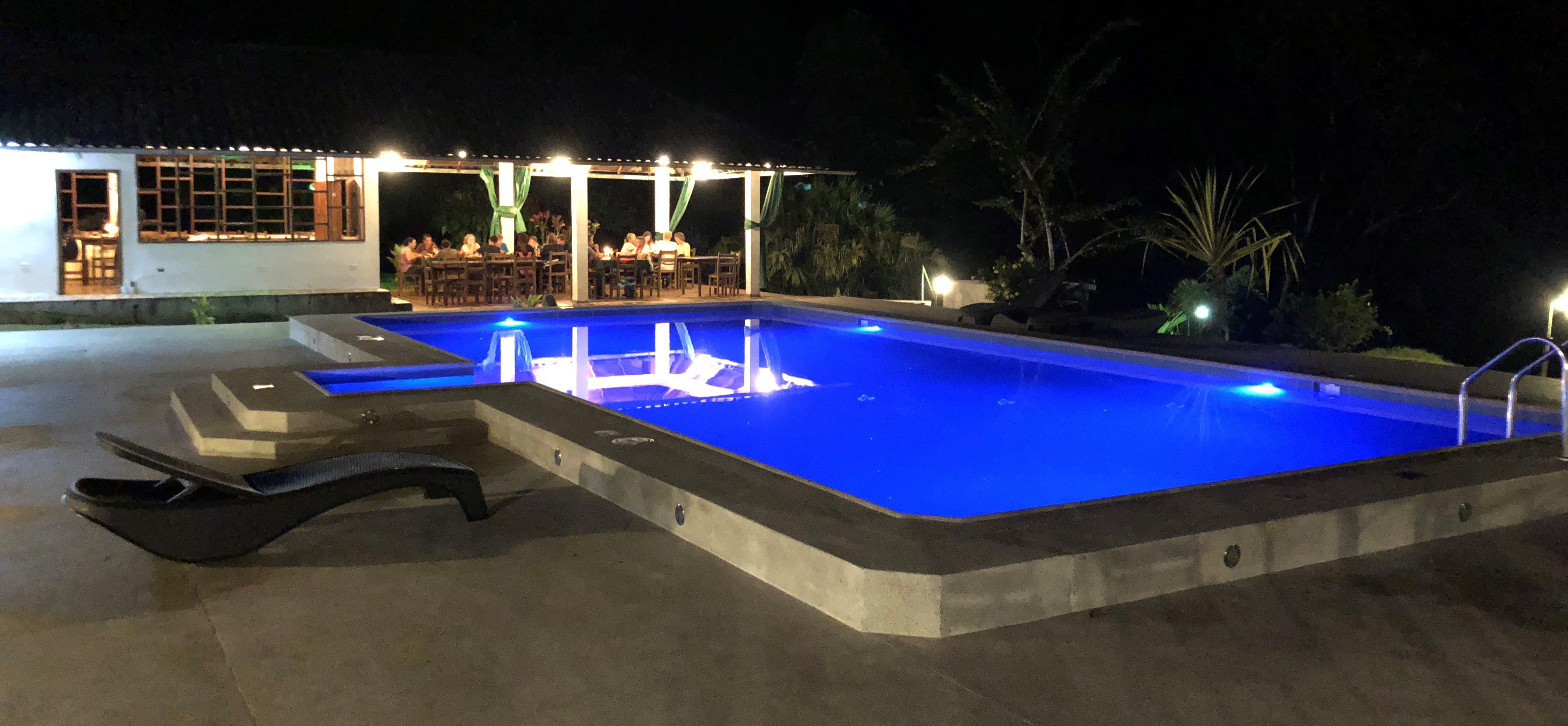
El Jungle Lodge El Jardin Aleman
was opened in
January 1996 and is surrounded by 125 ha
primary
and secondary rainforest. Apart from the hotel
grounds, belongs to the Lodge 100 ha protected
rainforest on the banks of the Napo River. The
resort
is built on 5 ha.
The Lodge is located on the banks of
Misahuallí
River, a tributary of Napo River , which
forms after about 1400 km, in Perú, the Amazon.
These rivers are so called White Waters.
That
means that they or their tributaries rise in the
Andes Mountains and they always carry sediments
along. This is also why they are relatively entrophic and they look muddy and dirty because
of
the stirred up sediments. The opposite is Black
Water. These rivers or lakes rise in the Amazon
Basin by ground or rainwater; because of
weathering of plants, they are very acid and dark,
but clear and oligotrophic water.
The
closed village to the hotel, 4 kilometers away, is
Misahuallí. For a
long
time Misahuallí village has seen the end of the road and
the starting point for journeys into the Ecuadorian
part of the Amazon rainforest, which was completely
undeveloped until the discovery of petrol 30 years
ago.
Here at the foot of the Andes the altitude is about
450 meter. It falls a lot of rain, from 3500 to 4000
mm per year. There are no marked seasons
because of
nearby equator. The rainfalls are spread equally
over all the year; but specially from June to
November.
The temperature is in between 15-18° C by night
and
28-33 C during day.
During rainy season the jungle is most
attractive and the rivers are most navigable.
Clothing is the same all the year: light,
cotton clothes, long pants and long-sleeved shirts
for the jungle walks, sun hats and sunglasses
indispensable. (Rubber boots you get in your
Lodge).
Don't forget your photo camera! The average
of
the daytime temperature is every day almost the
same. There is a very high atmospheric humidity
for
which reason you have the impression that the
temperature is higher.
In
the so-called upper Napo
region live the indigenous
Quichua. The main cultivation is among
others the Yuca (the most important local staple
food, a starch root), several species of bananas
and
rice (both imported from Asia, nowadays staple
food), corn (mainly for feeding animals), coffee and
cocoa (for sale) and fruits such as
pineapple,
papaya, citric fruits, avocado and chirimoya.
The plants, which will be presented by your guide
during the
jungle tours
can only be a part of the unbelievable botanical
diversity of the Amazon region. They are chosen because
of
their importance and utilization as food, medicinal
plant, coloring, drug or building material for the
natives.
|